My friend and I planned to go to the Lower Pierce Reservoir for a night macro-photography session and thankfully the weather was nice and dry. This is surprising as it is monsoon season in Singapore and getting a dry day during this period is not that common.
When we reached there, I was surprised to find a sounder of wild boars foraging for food at the edge of a small knoll next to the road leading into the reservoir. This is the first time I encounter such a large number of about 10 boars on the island of Singapore. The largest sounder I ever encountered was on the Pulau Ubin island with about 14 boars, big and small.
The boars were about 50 meters from us and so in order not to startle them, I decided to go without flash and use only my LED torchlight for lighting. Here's a photograph of about half the sounder. Pardon the poor quality as it was taken handheld without flash and manual focus. This is a new experience for me as this is the first time that I tried to manually focus in very dim lighting condition and in a hurry, just in case the boars decided to run off.
Although it was exciting to be able to photograph a large sounder of wild boars like this, it also sadden my heart to see the new destruction made by them - up-turned grass turf and broken tree logs.
After the excitement of encountering the wild boars, we decided to head straight for the "clearing" that I found several months ago. It has been a while that I have last went back to the spot due to the "discovery" of other spots in the area. Similar to the "clearing" at Venus Drive, the "clearing" is no longer a "clearing" as all the small trees that was planted at the place have grown much taller and broader, making movement through them almost impossible. Anyway we decided to brave the thick foliage and tall grass since we are already there. The first beetle that greeted us was a common Chafer Beetle (Apogonia expeditionis).
Next to the Apogonia expeditionis Chafer Beetle was another commonly encountered Chafer Beetle (Adoretus compressus). Noticed the badly eaten leaf. I guessed this is one of the reasons that they are considered to be a pest.
On the logs that marked the boundary of the clearing were tens of this 10 mm Darkling Beetles. This is a common type of Darkling Beetle which one would find on any fallen or rotting tree log, especially in the night.
Equally numerous was this small 5 mm Darkling Beetle, also commonly found on fallen logs in the area.
Another commonly found Darkling Beetle (Ceropria induta) was also found on the same tree log.
I was not expecting to see this type of Tiger Beetle (Cicindela aurulenta) but ended up finding many of them in the area.
The initial part of the "clearing" was really tough due to the low tree branches and tall grass. I was surprised to find this lone Fungus Weevil (Eucorynus crassicornis) on a blade of grass as this type of beetle would usually be found on fallen logs and not grass.
While I was photographing some yellow colored puff-ball mushrooms, my friend was happily photographing this metallic blue colored Leaf Beetle. After he was done with it, we switched position for me to catch some nice shots of it also.
After braving the thick foliage, we finally came to the part where there were a long line of fallen tree, which seemed to be purposefully placed to demarcate the edge of the "clearing". On the logs, we were surprised to find a large number of this lovely Ground Beetle (Catascopus dalbertisi) running actively on the logs.
On a blade of grass next to one of the fallen log was a lone Fungus Beetle (Eumorphus assamensis). This type of beetle can occasionally be found on grass or low trees next to fallen tree logs,
On the log next to the Fungus Beetle was a beetle larvae. This particular specimen looked slightly different in pattern from the ones that I usually find,
After checking out a large fallen tree, I saw a 15 mm black beetle on the underside of a thick vine. It was not possible to photograph it as it was almost at the base of the vine near to the ground. Instinctively, I use my pinky finger to nudge it to move away from the underside and up the vine. I was taken by surprised when I felt a searing heat on my pinky finger as the beetle dropped off from the vine into the leave litters below.
Not sure what kind of beetle was it but it seemed to me that it could be a Bombardier Beetle that I read about on the internet. Wonder if this is the first Bombardier Beetle encounter in Singapore. Sadly, I was not able to get any photograph for identification.
Here's a shot of the area where I felt the burning heat from the beetle. Although it looked like a serious burn, it is not as I do not feel any pain on it nor is there any blistering. It seemed to be the coloration of the chemical that caused the heat and it remained despite washing it several times with soap.
Near to the mysterious beetle was a first-time-encountered beetle. It looked very much like the black beetle that I encountered earlier on, but I am not about to find out this time round. From the shape of this beetle, it looked more like a Ground Beetle though.
Moving on, I was surprised to find this Fungus Beetle (Encymon scintillans scintillans) resting on a leave. The coloration of this beetle is interesting as it looked like the color of oxidized bronze.
Near to the Fungus Beetle was a log with several of this Fungus Beetle.
While photographing the Fungus Beetle, I chanced upon this deformed Net-winged Beetle on a blade of grass.
On the same log as the Fungus Beetle was this tiny 3 mm Rove Beetle. Photographing this tiny beetle was always a challenge due to its speed of moving around, so I took to a random-snap approach and managed to catch a few shots of it.
Moving to another log, I was surprised to find this Darkling Beetle (Cryphaeus gazelle). Its been a while that I last encounter this type of beetle. This is a female specimen as it lacks the horn-like protrusion found on male beetles.
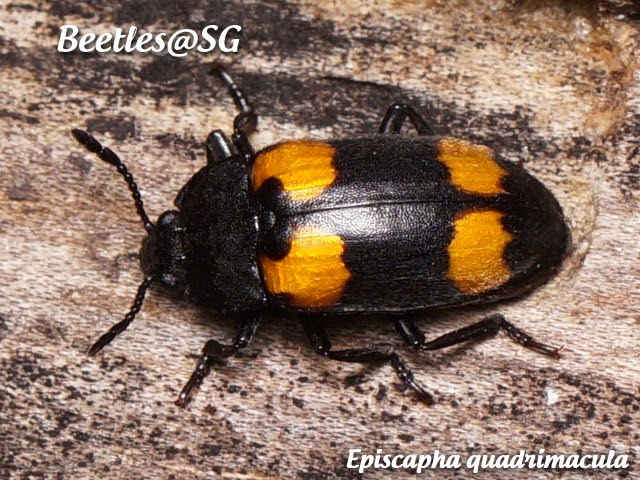
On another log was this Fungus Beetle (Episcapha quadrimacula). At a cursory glance, one would think that this is the same type of Fungus Beetle encountered earlier on. Only when you take a closer look that you can spot the difference in its pattern. In fact, many of the Fungus Beetle looked like each other at a glance until you take the time to note the difference in their pattern on the elytra.
Moving to another log, I was happy to find this 12 mm first-time-encountered Click Beetle. It was hyper-active and was trying to fit itself into the hole (shown in the photograph), but without success.
Just a few centimeters away from the Click Beetle was a Darkling Beetle with bright red legs.
There were a number of fallen logs at this place and on them were many different critters, beetles especially. Here's is a cute, ball-like beetle (Martinezostes sp.).
On the same log was a Fungus Beetle (Eurmorphus quadriguttatus quadriguttatus).
The weather was warm and humid, and I am almost out of drinking water (which is quite rare as I usually do not consume so much water on my night walks as compared to the day). At the same time, it was getting late and so we decided to slowly make our way out of the clearing. Just as I was moving out, this large 15 mm Darkling Beetle was found on the side of a log.
Just then my friend called out to me that he found a Long Horned Beetle and I quickly moved to the spot and found this Fungus Weevil. It was not surprising that my friend mistook it for a Long Horned Beetle as this type of beetle has very long antennae, especially the male beetle. Here's the blog when I first encountered this type of beetle ( Early Morning Walk At Venus Drive (30 Aug 2014) )
As we picked up our paces, I noticed a small 4 mm first-time-encountered Darkling Beetle resting on leave.
Just a stone's throw from the Darkling Beetle was another first-time-encountered Net-winged Beetle. The coloration of these beetles was so lovely, especially contrasted against the green grass background.
The last beetle before we concluded our trip was this Leaf Beetle (Lema rufotestacea). It was a good find even though it is a commonly encountered beetle as they are hyper-sensitive during the day and I was not able to get any good shots of them during my morning walks.
This trip was a fruitful one with several first-time-encountered beetle. It is definitely a memorable one too - the encounter with the sounder of wild boars and the mysterious beetle that burns a mark on my pinky finger. I would definitely go back to the place in the future.
The intent of this blog is to provide a platform for the sharing of information and knowledge on beetles found in Singapore. Your contributions to Beetles@SG website are most welcomed. If you have any photographs or information on beetles found in Singapore and would like to share them, please feel free and send them to me at davidmoh1313@gmail.com or leave a comment at my Beetles@SG Website http://davidmoh1313.wixsite.com/beetlesg
Beetle@SG Website
Please check out my website Beetles@SG for identification of beetles found in Singapore https://davidmoh1313.wixsite.com/beetlesg
Showing posts with label Lower Pierce Reservoir. Show all posts
Friday, 5 December 2014
Sunday, 14 September 2014
Night Walk At Lower Pierce Reservoir (12 Sep 2014)
The last time I went to the Lower Pierce Reservoir with a friend was interesting and hence I decided to give the place a try again. While I was happily photographing some of the beetles there, I saw two sets of eye-shine and I thought they were cats. Out of curiosity, I decided to check them out and was surprised to find a pair of Lesser Mousedeer (Tragulus javanicus fulviventer). Lesser Mousedeer is considered to be endangered in Singapore and encountering them in the wild was a real treat.
The first beetle that I encounter was a common Darkling Beetle.
On the same log was another Darkling Beetle crawling about near by.
The Fungus Weevil (Eucorynus crassicornis) were out in numbers on another log.
Moving further down the trail, I found a Straits Rhododendron (Melastoma malabathricum) plant that was badly damaged by several of this Chafer Beetle (Adoretus compressus).
Moving to a low tree, a tiny first-time-encountered Ladybird Beetle was seen resting on a young leaf.
On fallen tree nearby was a lovely metallic colored Darkling Beetle.
Hiding among the flowers of an Ixora plant, a Chafer Beetle (Apogonia expeditionis) was found feeding on the flowers.
A few of this Darkling Beetle (Ceropria induta) were seen foraging on a dried up log near by.
Moving to an area of low bushes, I was surprised to find a large number of Tiger Beetle (Cicindela aurulenta).
At an area similar to that of the "clearing" in Venus Drive, a number of this Ground Beetle (Catascopus dalbertisi) was seen resting on the side of the tree logs that lined the perimeter of the "clearing".
On the end of the same logs was a small mite infested Weevil Beetle.
Moving deeper into the "clearing", I found the only pair of Fungus Beetle for the night. It was rather strange as I used to find hundreds of them at the same location not too long ago.
On another tree log was a lone 5 mm Darkling Beetle.
Time passes quickly and it was time to leave the place. The last beetle that I managed to find was a lovely orange color Soldier Beetle.
The trip was not as fruitful as I expected but the encounter with the Lesser Mousedeer was more than worth the while for the trip.
Saturday, 16 August 2014
Night Walk At Lower Pierce Reservoir (15 Aug 2014)
It has been raining the entire day until late afternoon when the sun finally peeked through the clouds. With the wet weather in mind, my friend and I decided to go to either Venus Drive or Lower Pierce Reservoir for our night macro shoot. We took the risk of going to Lower Pierce Reservoir even though the chances of finding beetles after a whole day of rain at the place would be low compared to Venus Drive.
The purpose of the trip was multiple fold, first it was to test out my camera as I just collected it back from the Sony Service Centre. Secondly, it was to test out the Sony F43M external flash and TAMRON 60mm Macro Lens that I bought just a week ago. And lastly, it was to test out my DIY illuminating light made from a cup noodle container.
The trip started from Casuarina Road after a not so fantastic wanton-noodle dinner at an eatery there. We started to walk along the Old Upper Thomas Road and it was pretty slow moving as there were very few insects found, let alone finding beetles. While we were walking down the road, I was wondering if we had made a mistake in choosing Lower Pierce Reservoir.
I am glad that after walking for about 10 minutes, we finally found a beetle even though it may be a commonly encountered male Chafer Beetle (Adoretus compressus).
Moving further down was another Chafer Beetle (Adoretus compressus) which has a different coloration and pattern. I believed this to be a female Adoretus compressus Chafer Beetle. This is a common beetle and I have not noticed the large round eyes until now.
Near to the Chafer Beetle was a Fungus Beetle, hiding at the base of a tree.
We walked for another while without encountering any beetles until we came to a plant with some lovely looking red and pink flowers. Upon looking closer, I was glad to find this first-time-encountered hairy Chafer Beetle.
A stone's throw from the first-time-encountered Chafer Beetle was another Chafer Beetle (Apogonia expeditionis).
It seemed interesting that the beetles that we encountered so far were Chafer Beetles, until this Long Horned Beetle (Epepeotes luscus) was found resting among some thick foliage.
Walking along the Old Upper Thomson Road seemed not too fruitful and so we decided to pick up our paces to Lower Pierce Reservoir. The first beetle that greeted us there was a Chafer Beetle (Anomala albopilosa) that I seldom come across in my past trips. More Chafer Beetles to come?
The location that we went were full of this Darkling Beetles and they can be seen on literally every fallen log that we came across at the place.
As we walked along the low bushes, another Chafer Beetle was found.
Moving further into the bushes, I found this jittery Fungus Beetle that moved nervously up and down a large leaf.
Moving along, we were surprised to find a number of Tiger Beetles (Cicindela aurulenta) resting in the low bushes. This reminded us of the crashed Tiger Beetle colony at Ang Mo Kio Town Garden West.
Hiding in a plant with some large leaves, this first-time-encountered Click Beetle remained motionless for us to photograph to our hearts' contend.
We finally reached the area where there are many fallen logs. On these logs there were a number of this type of Ground Beetle (Catascopus dalbertisi).
On the same log with the Catascopus dalbertisi Ground Beetle was this Fungus Beetle (Episcapha quadrimacula). Interestingly there were only a few of this beetle, as compared to previous visits where there were easily a few tens of them.
Together with the Fungus Beetles and Ground Beetles were many of this small 10 mm Darkling Beetles.
Equally numerous were this type of Fungus Weevil (Eucorynus crassicornis).
Moving around the place, I noticed a tiny 3 mm Darkling Beetle among all the bigger 10 mm Darkling Beetles.
On one of the logs were several of this lovely colored beetle larvae.
On the same log was this well camouflage Weevil Beetle. From the wetness of the body of this beetle, you can see that it rained pretty heavy a short while ago.
On another log was this Fungus Beetle (Eumorphus assamensis). This one was particularly skittish and quickly moved into some crevices to hide. Noticed that this beetle was also wet from the rain.
Time passes quickly and it was time for us to leave. At the toilet where we cleaned up, I found this first-time-encountered Click Beetle. Fancy finding beetles in the toilet, they must have been attracted by the florescent light in the toilet.
Near to the Click Beetle was another first-time-encountered beetle that looked very much like a cross between a Click Beetle and a Firefly Beetle.
This trip was a fruitful one despite the slow start. It was interesting to find so many different Chafer Beetles on one trip, and to be able to find first-time-encountered beetles, especially in the toilet. At the same time, the testing of the camera and lighting also turned out well. This is a good trip indeed.
Subscribe to:
Posts (Atom)